

Ray-Ban has been making some of the world's most recognizable sunglasses for decades. The Aviator, Wayfarer, and Clubmaster have become classics, and their popularity shows no signs of fading.
Unfortunately, that popularity comes with a downside. Ray-Ban sunglasses are widely copied, and some counterfeits look surprisingly close to the real thing.
A fake pair might have the familiar logo, a branded case, and even the correct model number printed inside the frame. Unless you know what to look for, telling the difference isn't always easy.
So how do you know if your Ray-Bans are genuine?
There are several details worth checking, from the tiny engraving on the lens to the hinges, model number, and packaging. None of these checks is foolproof on its own, but together they can help you identify a suspicious pair.
Here are eight things to look for before buying Ray-Ban sunglasses, or if you're having doubts about a pair you already own.
1. Check the Ray-Ban Logo on the Lens
The first thing to inspect is the Ray-Ban logo.
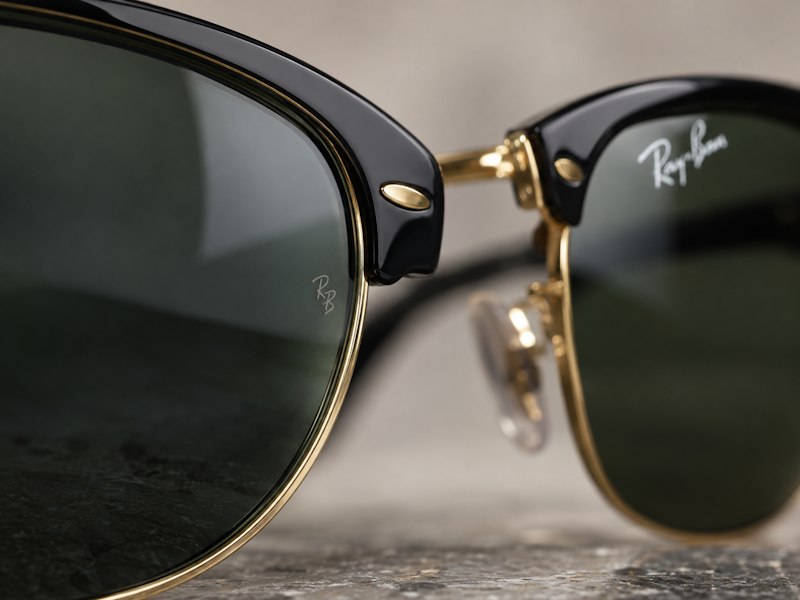
On most genuine Ray-Ban sunglasses with original lenses, you'll find the white Ray-Ban signature near the upper corner of the right lens.
Take a close look. The lettering should be sharp and evenly printed, without strange spacing or blurry edges.
Fake sunglasses sometimes have logos that look slightly too thick, crooked, or just different from the original.
The easiest way to check is to open a photo of the same model on the official Ray-Ban website and compare them.
Don't forget that some genuine Ray-Ban frames have replacement or prescription lenses. In those cases, the original logo might be missing.
2. Look for the Small RB Engraving
There's another marking that's much less noticeable than the Ray-Ban logo.
On most modern Ray-Ban sunglasses with original lenses, you'll find a tiny RB engraving on the left lens, close to the outer edge.
It's not always easy to spot. Try holding the sunglasses near a light and tilting them slightly.
The engraving should look clean and subtle. If it's unusually large, badly positioned, or looks roughly scratched into the lens, that's worth investigating.
But don't rely entirely on this detail.
Some older Ray-Ban sunglasses have different markings, and replacement lenses might not have the engraving at all. Counterfeiters can also copy it.
It's a useful check, but not enough to establish whether a pair is genuine.
3. Verify the Ray-Ban Model Number
This is one of the most helpful checks, especially if you're buying sunglasses online.
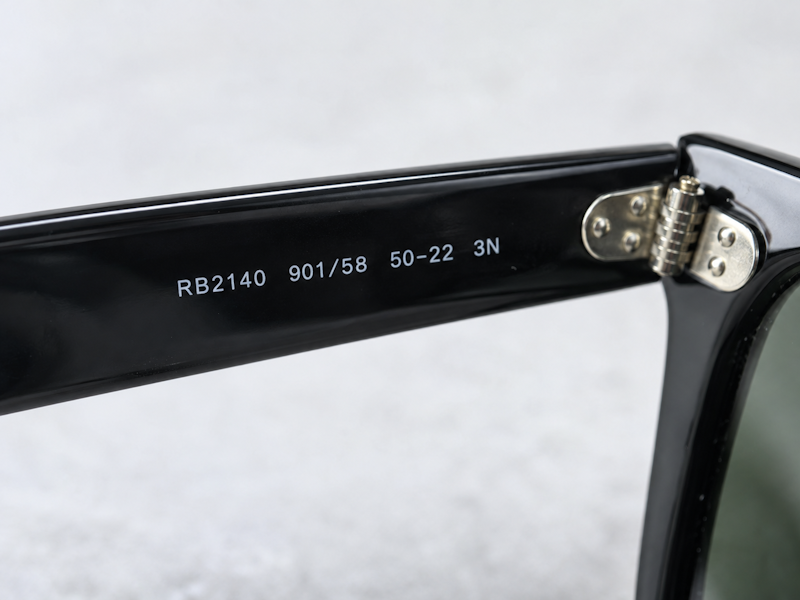
Look inside the temples, the two arms that sit over your ears. Genuine Ray-Bans generally have identifying information printed there, including the model number, color code, and size.
For example, you might find:
RB2140 901/58 50-22
Here's what it means:
- RB2140: Original Wayfarer model.
- 901/58: Black frame with green polarized lenses.
- 50-22: Lens width of 50 mm and bridge width of 22 mm.
Now check whether those details actually match the sunglasses.
If the code identifies a black Wayfarer but the sunglasses have a completely different shape or color combination, something isn't right.
Popular Ray-Ban Models and Their Numbers
Here are some of the most common Ray-Ban models you'll come across:
| Ray-Ban model | Model number |
|---|---|
| Original Wayfarer Classic | RB2140 |
| New Wayfarer Classic | RB2132 |
| Aviator Classic | RB3025 |
| Clubmaster Classic | RB3016 |
| Round Metal | RB3447 |
| Justin Classic | RB4165 |
| Erika Classic | RB4171 |
Keep in mind that these numbers identify model families, not every possible variation.
For instance, the Ray-Ban Aviator RB3025 is available with several frame finishes, lens colors, and polarized options.
When checking authenticity, search for the complete model and color code rather than just the model number.
Also, remember that counterfeiters can print genuine Ray-Ban codes on fake frames. A matching number is a good sign, but it isn't proof.
4. Inspect the Nose Pads and Small Frame Details
It's often the little details that separate a well-made pair of sunglasses from a cheap imitation.
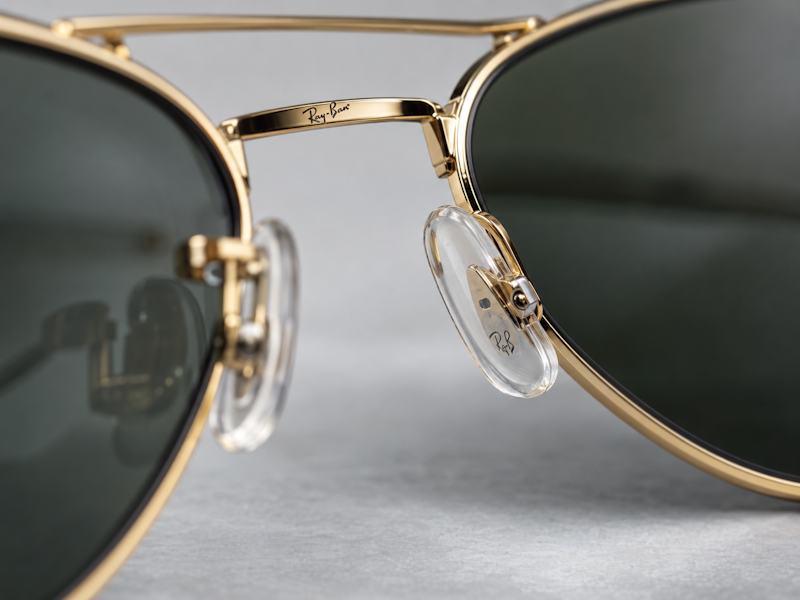
Take the classic Ray-Ban Aviator RB3025. Its adjustable nose pads commonly have small RB markings. On a genuine pair, these details should be neatly finished and properly positioned.
If you're examining an Original Wayfarer RB2140, look closely at the metal decorations on the front of the frame.
With the Clubmaster RB3016, pay attention to the connection between the thicker upper frame and the thin metal rim.
Compare these details with official photographs of the exact model.
Uneven decorations, poorly fitted nose pads, or rough metal edges are all reasons to take a closer look.
And one important point: not all genuine Ray-Bans are made in Italy. Ray-Ban has also manufactured authentic sunglasses in China.
So if you see "Made in China" inside the frame, don't automatically assume it's a fake.
5. Check the Hinges and Overall Frame Quality
Pick up the sunglasses and open and close the arms a few times.
Do the hinges move smoothly? Do the temples feel secure? Are the edges and joints neatly finished?
Genuine Ray-Ban sunglasses should generally feel well assembled.
Cheap counterfeits often have loose hinges, uneven joints, rough plastic, or visible glue around the frame.
Of course, even an original pair can develop loose hinges or worn components after years of use. That's why the condition and age of the sunglasses matter.
You might also hear people say that real Ray-Bans should feel heavy.
That's not necessarily true.
The metal RB3025 Aviator feels very different from the RB4165 Justin or the lightweight RB4171 Erika.
Weight alone tells you very little. What matters more is whether the materials, construction, and finishing match the original model.
6. Examine the Lenses and Polarization
The lenses deserve just as much attention as the frame.
Try looking through the sunglasses at something with straight lines, such as a window frame or door.
Move the glasses slowly from side to side. If the lines appear noticeably distorted or wavy, the lenses may have an optical quality problem.
Also look for uneven tinting, visible defects, or other irregularities.
If the sunglasses are supposed to be polarized, check the Ray-Ban signature on the right lens.
Original Ray-Ban polarized lenses normally have a small P next to the Ray-Ban logo.
You can also perform a simple polarization check using a compatible LCD screen. Look at the screen through the sunglasses and rotate them slowly. The brightness should change.
But don't confuse polarization with authenticity.
Fake sunglasses can have polarized lenses too. They can even have copied Ray-Ban P markings.
The same goes for UV protection. Dark lenses don't necessarily provide adequate protection from UV rays.
If you aren't sure about the UV protection, an optician can check the lenses using the proper equipment.
7. Look at the Packaging and Accessories
Ray-Ban sunglasses commonly come with a branded case, cleaning cloth, and product packaging.
These accessories can give you useful clues, particularly when the sunglasses are being sold as brand new.
Start with the box label.
Does the model number match the frame? Are the color code, lens type, and size correct?
Then examine the case and cleaning cloth. Poor stitching, badly printed logos, or obvious spelling mistakes can be warning signs.
However, don't expect every genuine Ray-Ban case to look identical.
Packaging can differ between collections, countries, and production periods.
And because counterfeiters copy packaging too, even a perfect-looking Ray-Ban box doesn't guarantee that the sunglasses inside are genuine.
Focus on whether the product and its accessories make sense together.
8. Be Careful with Extremely Low Prices
Finding Ray-Bans at a good discount is great. Finding a brand-new pair of Aviators at a price that seems almost impossible deserves a little more attention.
Before ordering, take a look at the seller.
Is it an established business? Does the website provide proper contact details? Is there a clear return policy? Can you find reliable information about the store?
Be particularly cautious of websites that imitate Ray-Ban's official domain or advertise enormous discounts on nearly every model.
That doesn't mean every inexpensive pair is fake.
Legitimate retailers sometimes offer substantial discounts on older collections, discontinued colors, and clearance items.
Also, independent stores can sell genuine Ray-Bans without being official authorized dealers.
A low price alone isn't proof of anything. The product details and the seller's credibility are far more useful when making your decision.
Frequently Asked Questions About Fake Ray-Ban Sunglasses
How can I quickly tell if my Ray-Bans are fake?
Start by checking the Ray-Ban logo on the right lens, the small RB engraving on the left lens, and the model information inside the temples. Then compare the frame with official photographs of the same model. If several details don't match, the sunglasses deserve closer inspection.
Do all genuine Ray-Bans have an RB engraving?
Many modern Ray-Ban sunglasses with original lenses have one, but not every genuine pair will. Older models and sunglasses with replacement lenses may have different markings.
Are Ray-Bans made in China fake?
No. Genuine Ray-Ban sunglasses have been manufactured in China as well as Italy. The country of manufacture is not a reliable authenticity test by itself.
Can fake Ray-Bans have polarized lenses?
Yes. Polarized lenses are not exclusive to genuine Ray-Bans. Some counterfeits have polarization and even copied Ray-Ban P markings.
Can I check Ray-Ban authenticity using the model number?
The model number can help you confirm whether the frame design, color, and measurements match an actual Ray-Ban product. However, counterfeiters can copy legitimate codes, so the number alone cannot prove authenticity.
Final Thoughts: Don't Rely on Just One Detail
Spotting fake Ray-Ban sunglasses isn't always as simple as finding a missing logo or a cheap-looking case.
Some counterfeits are easy to recognize, while others copy nearly every visible detail of the original.
That's why it's worth checking several things before deciding.
If you're looking at a popular model like the RB2140 Wayfarer, RB3025 Aviator, or RB3016 Clubmaster, start with the model information, compare the frame and lenses with official photographs, and pay attention to the seller.
A missing marking doesn't necessarily mean the sunglasses are fake, just as a perfect-looking logo doesn't guarantee they're real.
The more details you check, the better your chances of avoiding counterfeit sunglasses and getting the genuine Ray-Bans you're paying for.