
WORLDWIDE SHIPPING

Coach bags have earned their place in the handbag world for good reason. The brand combines recognizable designs with practical details, quality materials, and a history stretching back to 1941. Unfortunately, that popularity has also made Coach a target for counterfeiters.
And spotting a fake isn't always straightforward.
Some counterfeit Coach bags are poorly made and relatively easy to identify. Others look convincing in photographs, complete with branded hardware, leather tags, and seemingly legitimate serial numbers.
So, how can you tell if a Coach bag is real?
Start by checking the bag's style number, interior Storypatch, stitching, hardware, materials, and overall construction against a verified example of the same model. Then consider where the bag was purchased and whether its details match the seller's description.
The key is to examine several features together. No single serial number, logo, or zipper stamp can guarantee authenticity.
Here's what deserves your attention.
One of the first places buyers look when authenticating a Coach handbag is the number inside.
That's a sensible starting point, but there's a common misunderstanding: a Coach style number is not necessarily a unique serial number identifying one individual handbag.
Coach has changed its identification systems over the decades. Older bags may feature serial numbers with formats associated with particular production periods, while many later styles include codes identifying the design.
Depending on the bag and its production period, identifying information may appear:
Coach describes its Storypatch as a distinctive part of its handbag heritage, featuring information about the brand's craftsmanship and a registration number.
Search the exact style number alongside the words "Coach bag."
For example, Coach's official website identifies the Tabby Shoulder Bag 26 in one configuration as style CP144. The Brooklyn Shoulder Bag 28 has an official listing under style CU068.
Compare the search results with your handbag's shape, dimensions, straps, pockets, materials, and hardware.
A mismatch between the style number and the actual design deserves further investigation.
However, don't immediately assume that an unfamiliar number means the bag is counterfeit. Older models, discontinued collections, and regional variations may be harder to research.
Remember: counterfeiters can copy legitimate numbers. Finding a matching number online is useful evidence, not proof of authenticity.
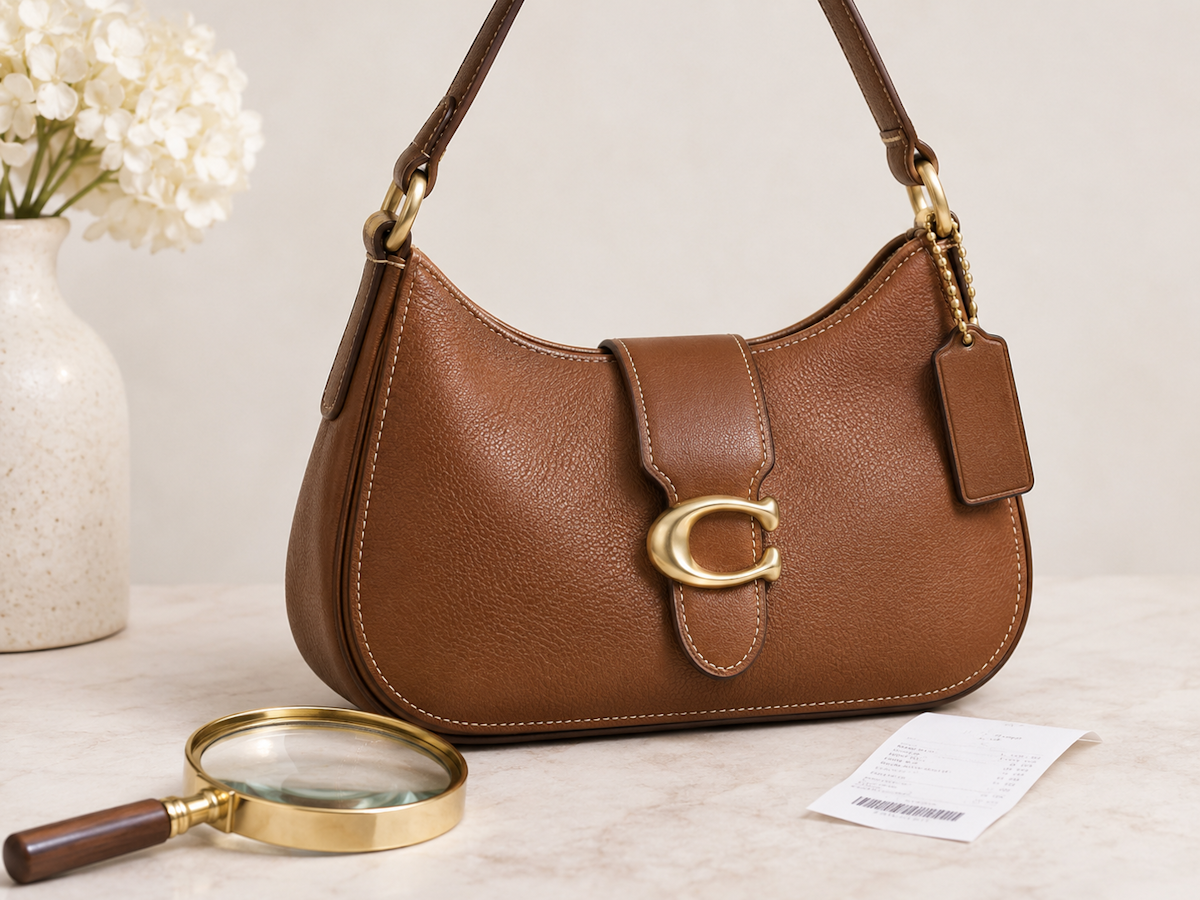
The interior Storypatch, sometimes called the creed patch, is one of Coach's most recognizable details.
It usually features embossed or printed text describing the brand or its craftsmanship, although its design and wording have changed over time.
A genuine patch should look appropriate for the specific bag and its production era.
Look closely at the lettering. Is the text clear? Are the letters properly formed? Does the patch sit naturally within the bag's construction?
Obvious spelling errors, inconsistent lettering, or a badly attached patch are warning signs.
Still, be careful about applying one set of rules to every Coach handbag.
A vintage leather bag may have a very different interior patch from a modern Coach Tabby. Some newer styles also use separate labels for production information.
The best approach is to compare the Storypatch with photographs of a verified example from the same collection and period.
A convincing patch alone doesn't establish authenticity. It's one more piece of the puzzle.
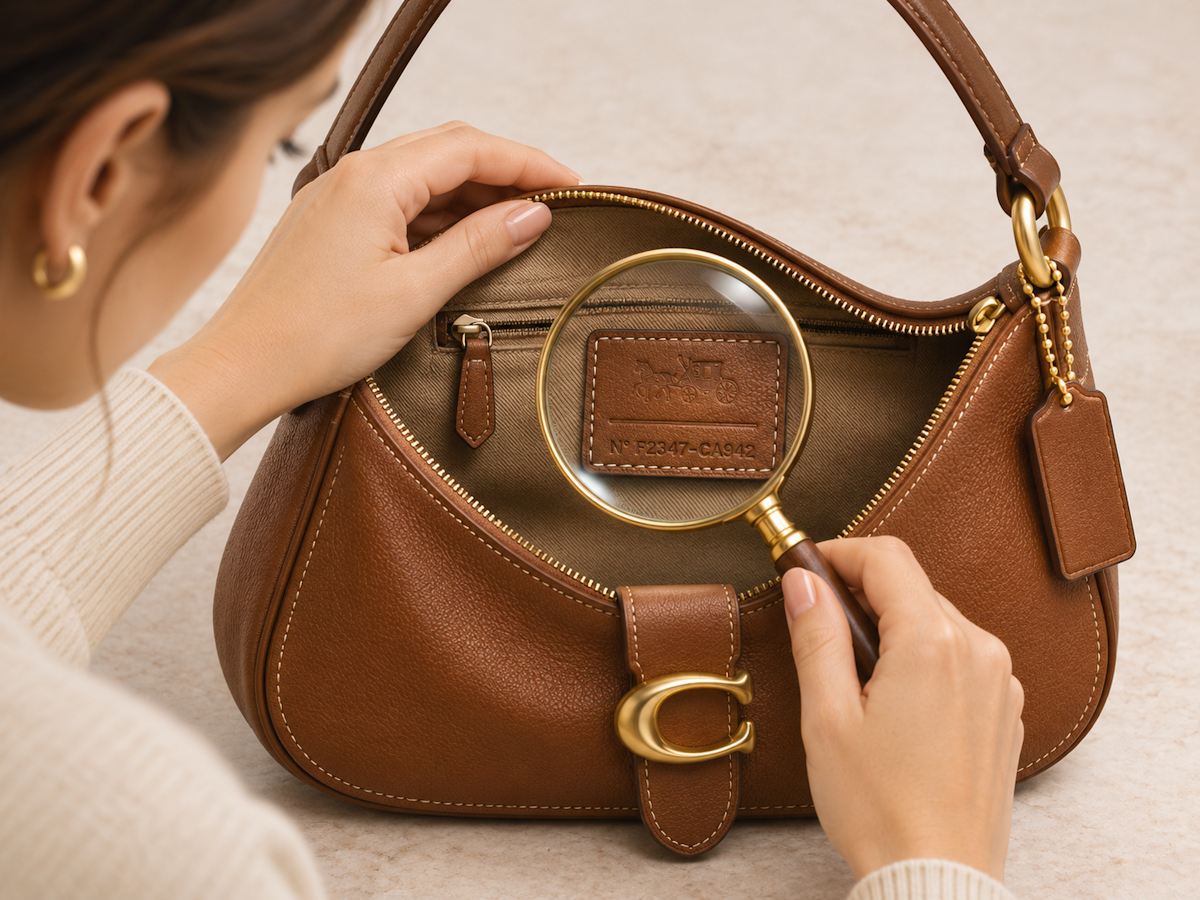
Good stitching is one of those details you don't always notice until something looks wrong.
Coach is known for attention to construction, so examining the seams is worthwhile.
Look at the stitching around the handles, corners, zipper openings, pockets, and areas where straps attach to the bag.
On a well-constructed handbag, stitching should generally be secure, reasonably even, and appropriate for the material.
Warning signs include loose threads on a supposedly new bag, seams pulling apart, irregularly placed stitches, or visibly careless repairs that haven't been disclosed.
Pay particular attention to stress points. These areas carry the weight of the handbag and its contents.
But don't rely on an internet rule claiming that every genuine Coach bag must have an exact number of stitches per inch.
Coach makes different handbags using different materials and construction methods. A structured leather shoulder bag and a soft canvas tote won't necessarily have identical stitching.
Also, secondhand bags may have undergone legitimate repairs.
Poor workmanship can raise suspicion, but one imperfect stitch doesn't automatically make a bag fake.
Coach uses several distinctive logos and design elements, including its horse-and-carriage emblem, COACH lettering, Signature C pattern, and Sculpted C hardware.
The important question isn't simply whether the logo looks familiar.
It's whether the logo matches the particular model you're examining.
On bags featuring Coach's Signature canvas or jacquard, inspect the pattern's scale, placement, and overall consistency.
Look for unusually distorted lettering, poor printing, or pattern placement that appears inconsistent with verified examples.
Don't assume that every authentic Coach bag has perfectly symmetrical Cs across every seam.
Pattern alignment can change around corners, pockets, and curved construction areas. Different Coach collections also feature different versions of the Signature design.
When present, the emblem should have a clear, recognizable design appropriate to that product.
Blurry lettering, distorted details, and visibly inaccurate proportions can be suspicious.
However, not every Coach handbag features the horse-and-carriage logo.
For example, the popular Coach Tabby collection is closely associated with prominent Sculpted C hardware.
Authentication depends on the exact model, not whether a handbag carries every recognizable Coach symbol.
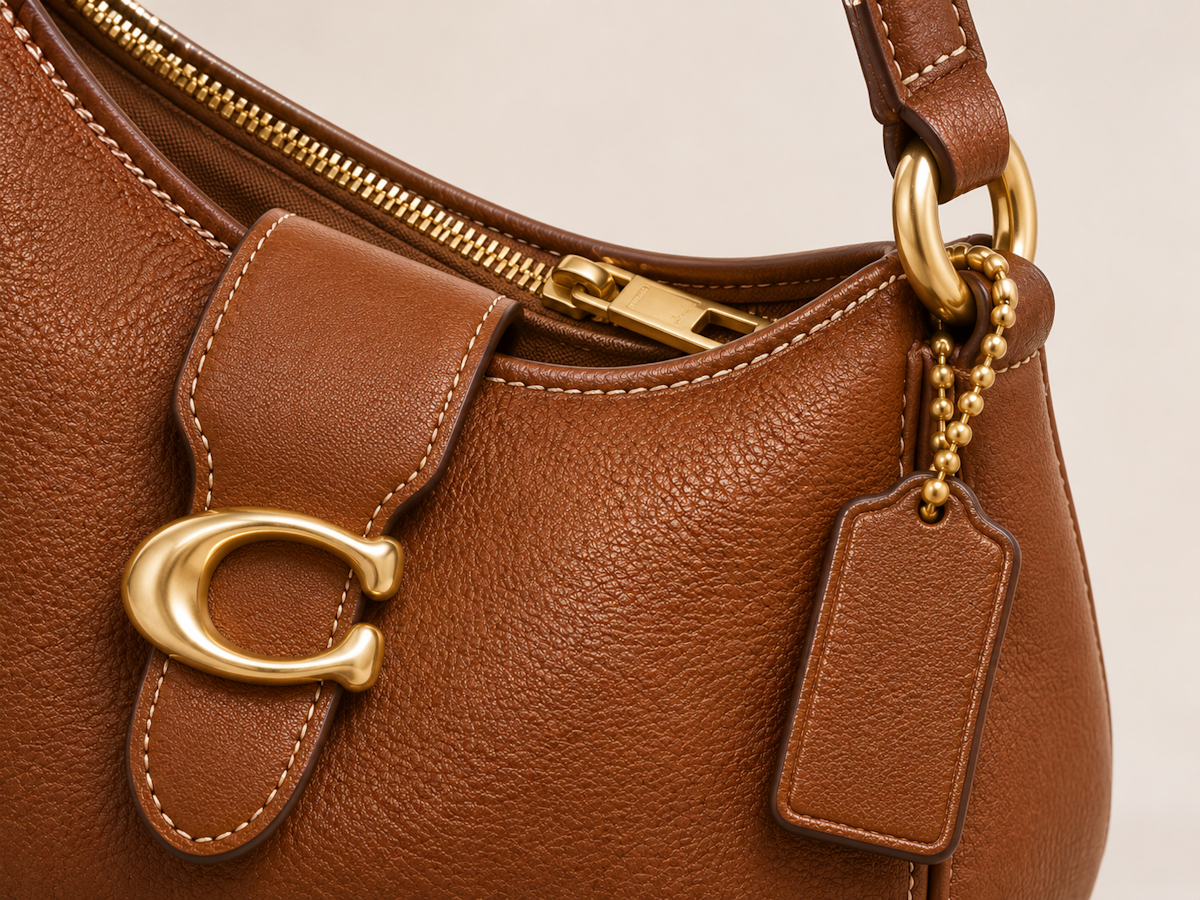
One of the more persistent misconceptions about Coach is that every authentic bag must feel thick, heavy, and exceptionally soft.
That's simply not how the brand's product range works.
Coach uses multiple leather types, including glovetanned leather, pebble leather, smooth calf leather, nappa leather, and crossgrain leather.
It also produces handbags in Signature canvas, jacquard, nylon, denim, suede, and other materials.
Each has a different texture and structure.
For instance, Coach describes its pebble leather as having a distinctive textured grain, while its nappa leather has a softer handfeel and natural sheen.
A structured crossgrain leather bag may feel firmer than a relaxed shoulder bag made from natural grain leather.
Neither characteristic automatically makes one less authentic.
Look for materials that noticeably contradict the official product description.
If a particular model is supposed to have leather lining but the bag you're inspecting has a completely different interior, investigate further.
Likewise, cracking synthetic-looking surfaces, poor edge finishing, or material that seems inconsistent with reliable photographs may indicate a problem.
Keep normal wear in mind, though. Leather can change texture, develop scratches, or soften with use.
And smell alone is not a reliable authentication method.
Hardware is often one of the most revealing parts of a handbag because it combines appearance with function.
Examine the zippers, buckles, rings, strap attachments, magnetic closures, and turnlocks.
Do the zippers move smoothly? Are the hardware pieces securely attached? Do the finishes and engravings resemble those shown in official photographs?
On a new bag, severely misaligned hardware, rough edges, or a closure that barely works should raise questions.
Not necessarily.
Some authentication guides suggest that all genuine Coach bags use YKK zippers. That's an oversimplification.
A YKK marking does not automatically prove that a handbag is authentic, and the absence of that marking is not sufficient evidence of a counterfeit.
A fake bag can use genuine third-party zipper components.
Instead, compare the zipper design, pull, placement, and construction with an authentic version of the same handbag.
Also, don't assume that every Coach bag must have heavy metal hardware.
Different collections use different finishes and component styles.
This is arguably the most useful practical step when checking a relatively recent Coach handbag.
Instead of relying on broad descriptions of what a real Coach bag should look like, compare your bag with the exact model.
Coach's official product pages often include measurements, materials, strap configurations, hardware details, and interior features.
Consider two popular styles.
The Coach Tabby Shoulder Bag 26, style CP144, is described by Coach as a structured bag made from glovetanned leather.
Its listed features include two detachable straps, an outside slip pocket, interior pockets, and a snap closure.
If a seller advertises this exact version but shows a different pocket arrangement or permanently attached straps, ask why.
Remember that the Tabby family includes many variations, so the comparison must be with the correct style and edition.
The Coach Brooklyn Shoulder Bag 28, style CU068, has a more relaxed silhouette.
Coach lists natural grain leather, a magnetic snap closure, an inside snap pocket, and a wide shoulder strap among its features.
That is a very different design from a structured Tabby.
The lesson is straightforward: a bag should match its own official specifications, not a generic checklist of Coach features.
For older or discontinued products, archived catalogs, historical product photographs, and reputable resale references may help establish the correct design.
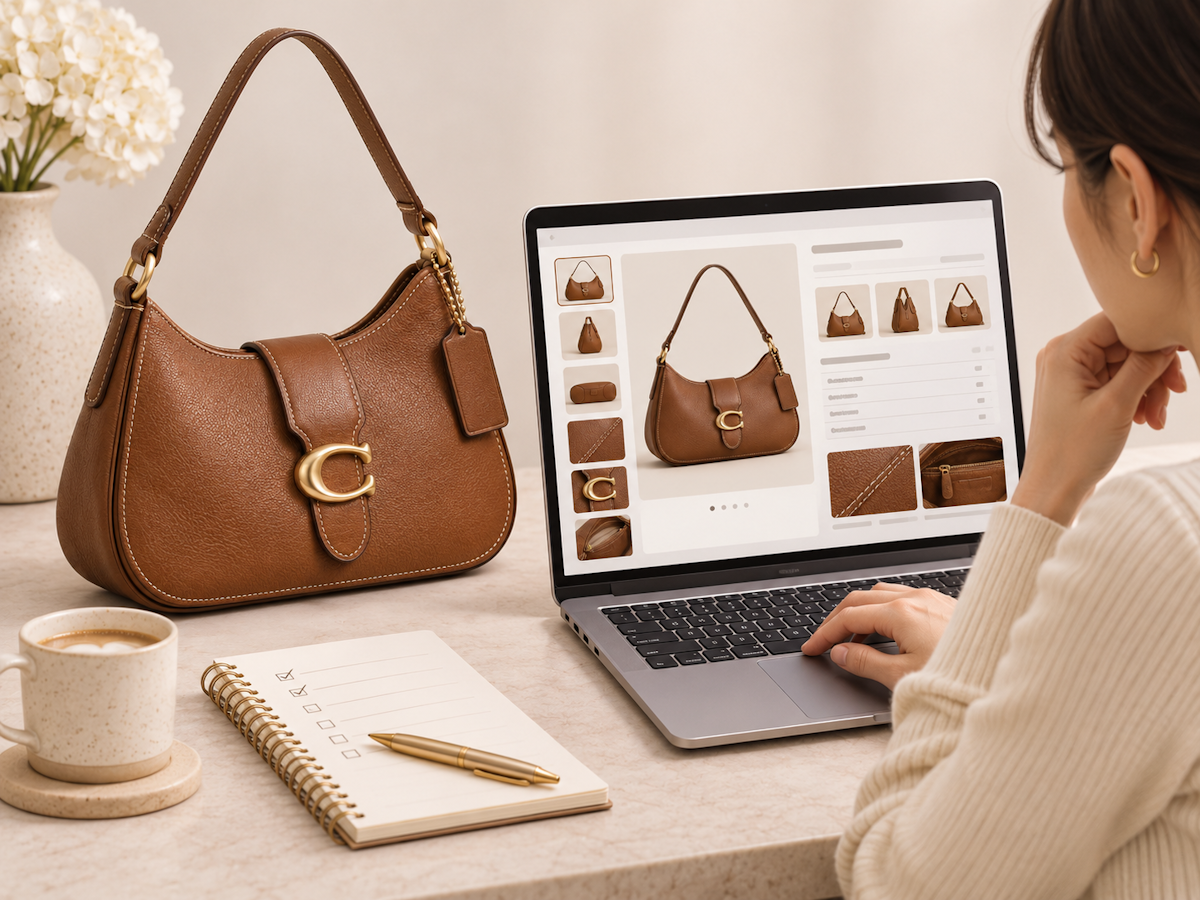
There's another question that regularly causes confusion: Are Coach Outlet bags real?
Yes. Genuine Coach Outlet handbags are authentic Coach products.
Coach explicitly identifies its retail stores, outlet stores, official websites, and authorized retail partners as legitimate sales channels.
However, Coach Outlet and regular Coach retail collections may contain different styles, materials, and design details.
Some products are produced specifically for outlet distribution, while others may be discounted merchandise from previous collections.
A lower outlet price doesn't mean a bag is fake.
You should also avoid assuming that two handbags with similar shapes and logos must have identical interiors or materials.
Compare each product with the appropriate retail or outlet listing.
For online shopping, use the official Coach Outlet website rather than trusting an unfamiliar website simply because it has "Coach Outlet" in its name.
A handbag arriving in beautiful packaging can make a good first impression.
It can't establish authenticity.
Counterfeit products may be accompanied by convincing shopping bags, dust bags, tags, care booklets, and receipts.
Likewise, an authentic pre-owned bag might no longer have any of its original packaging.
Coach does not establish a universal consumer rule that every genuine handbag must include a separate certificate of authenticity.
Be especially cautious when a seller presents an impressive-looking card as definitive proof.
A receipt or order confirmation from a recognized retailer can help establish purchase history, but documents and screenshots can also be altered.
Check whether the paperwork matches the model, color, purchase date, and seller's account.
The handbag itself still deserves careful inspection.
The seller matters just as much as the product photographs.
Coach warns consumers about counterfeit websites imitating official stores and about counterfeit merchandise appearing on auction platforms.
A price that seems unusually low should prompt additional questions, particularly for a popular style in new condition.
That doesn't mean every discounted handbag is suspicious.
Outlet promotions, seasonal sales, discontinued colors, and pre-owned condition can explain legitimate price differences.
What matters is whether the seller can support the product's origin and accurately describe its condition.
Before purchasing from an unfamiliar seller, check the business's history, return policy, payment protection, and product photographs.
If you're considering a secondhand handbag, ask for clear pictures of the actual item, not just stock images.
The interior labels, hardware, base, straps, and corners are especially useful.
A seller unwilling to provide basic photographs or answer reasonable product questions is a good reason to reconsider the purchase.
Several popular authentication tips sound convincing but aren't reliable when used alone.
| Common claim | What you should know |
|---|---|
| Every real Coach bag has a unique serial number | Identification formats have changed, and style numbers may identify a design rather than one individual bag. |
| All genuine Coach zippers say YKK | A zipper brand is not a universal authentication test. |
| A real Coach bag must be heavy | Weight varies considerably by design and material. |
| Coach Outlet bags are fake or inferior copies | Genuine Coach Outlet merchandise is authentic, although styles and specifications can differ. |
| A dust bag or receipt proves authenticity | Packaging and documents can be copied or altered. |
| Every Coach bag uses genuine leather throughout | Coach also produces authentic handbags in canvas, jacquard, nylon, and other materials. |
The problem with these rules is that they attempt to reduce a complicated process to a single detail.
Genuine Coach products have evolved over decades. Counterfeit manufacturing has evolved, too.
If something doesn't add up, avoid making an immediate accusation based on one suspicious feature.
Start by documenting the differences.
Take clear photographs of the exterior, interior, label, hardware, stitching, and any details that contradict the product listing.
Save the original advertisement, receipt, order confirmation, and communications with the seller.
Next, compare the bag with official product information, making sure you're looking at the same model and variation.
For expensive secondhand purchases, an experienced independent handbag authentication service may provide an additional assessment. Check the service's qualifications and whether its report is accepted by your marketplace or payment provider.
Coach's own brand-protection guidance states that the company does not respond to individual requests to authenticate products.
If you have credible reasons to believe an item is counterfeit, contact the seller promptly and use the relevant marketplace or payment provider's dispute procedure.
Suspected counterfeit listings can also be reported through Coach's official brand-protection channels.
Locate the interior identifying number and compare it with reliable information about the bag's model and production period. A matching number supports your investigation but does not prove authenticity because counterfeiters can copy legitimate codes.
Identification details vary by production period and design. Some information may appear on a small interior label rather than the main leather patch. If you cannot locate a number, examine the full bag and compare it with a verified example before drawing conclusions.
Yes. A country-of-origin label stating China does not automatically indicate a counterfeit. Coach has used international manufacturing, and authenticity should be evaluated using the complete product rather than assumptions about where it was made.
Absolutely. Counterfeiters can reproduce logos, embossed patches, hardware, and packaging. That's why visual accuracy in one area does not establish that the entire bag is authentic.
Coach states in its official brand-protection policy that it does not respond to requests to authenticate individual products. Buyers seeking an assessment of a pre-owned handbag may need an independent specialist.
No. Packaging varies, and secondhand bags may have lost their original accessories. Missing packaging alone is not evidence of counterfeiting.
Yes. Coach Outlet is an official Coach sales channel. Outlet products may differ from regular retail products, but legitimate outlet merchandise is genuine.
Authenticating a Coach handbag is less about finding one secret marking and more about recognizing a collection of consistent details.
The style number should make sense. The materials, hardware, construction, and interior features should match the specific model. The seller should have a credible explanation of where the bag came from.
A genuine Coach bag doesn't have to be flawless, particularly if it's vintage or well-loved. And a counterfeit doesn't always look cheap.
When several details agree with verified product information, you have stronger grounds for confidence. When important features contradict the official design, further investigation is warranted.
If uncertainty remains, don't treat a matching serial number or convincing logo as a final verdict. For a valuable purchase, professional authentication and a seller offering meaningful buyer protection are worth considering.

| OPTION | ||||
| STANDARD | FREE | N/A | 4-9 Business Days | N/A |
| REGISTERED | $9 | $25 | 3-7 Business Days | 5-21 Business Days |
| EXPRESS | $29 | $45 | 2-7 Business Days | 3-9 Business Days |
* DAS and CES may apply.
DAS: There are certain locations in the world where the shipping carriers charge extra fees to deliver packages to these locations. These fees are called DAS (Delivery Area Surcharge) and are usually charged by the carrier in areas that are less accessible for pickups and deliveries.
CES: There are certain cases where the shipping carriers charge extra fees to deliver packages for several reasons, for example: exceeding certain dimensions or weight, perfumes, etc. These fees are called CES (Courier Extra Surcharge).
Handling time: Our handling time is 1-3 business days after the payment has been received.
Import Fees: Any customs or import duties are charged once the parcel reaches its destination country must be paid by the recipient of the parcel. We have no control over these charges and cannot predict what they may be. Customs policies vary widely from country to country. You can contact your local customs office for further information.
For some countries, we calculate Duty VAT, Taxes, etc. following the laws and import regulations of the destination country. These fees are calculated based on destination, item type, and country of origin, manufacture or assembly.