

Cycling sunglasses have a harder job than ordinary sunglasses. They need to protect your eyes from UV radiation, certainly, but they also have to deal with wind, insects, road grit, changing light, sweat and the slightly awkward relationship between a pair of glasses and a cycling helmet.
That is why choosing cycling sunglasses purely because they look good is usually a mistake.
For most riders, the best cycling sunglasses combine a wide field of vision, reliable UV protection, secure grip, decent ventilation and a lens suited to the conditions in which they actually ride. Road cyclists may favor contrast and wind protection. Mountain bikers often need better ventilation and lenses that work when moving between open ground and tree cover. Long-distance riders usually care just as much about comfort after four hours as they do about optical quality during the first ten minutes.
We reviewed current manufacturer specifications, established cycling eyewear technologies and recent independent cycling tests when putting together this guide. Models were considered for their cycling-specific design, lens performance, coverage, fit, ventilation and continued relevance to riders rather than simply because they are new or expensive. Independent testing also matters: Cycling Weekly's 2026 cycling glasses guide, for example, continues to rate the Oakley Encoder as its best overall cycling sunglasses.
What should you look for in cycling sunglasses?
A good pair of cycling sunglasses should provide 100% UVA and UVB protection, broad coverage, a secure non-slip fit and clear vision without interfering with your helmet. Lens tint should match your usual riding conditions, while riders dealing with rapidly changing light may benefit from photochromic or interchangeable lenses.
UV protection comes first. The American Optometric Association recommends sunglasses that block 100% of UVA and UVB radiation, while wraparound designs can provide additional protection by reducing light entering from the sides. That wraparound shape happens to work particularly well for cycling because it can also reduce wind hitting the eyes at speed.
Coverage is the next thing we look at. Large shield lenses dominate performance cycling for a reason. When your head is tilted forward on a road bike, a small lifestyle frame can leave you staring over the top edge of the lens. A taller shield keeps more of the road inside the protected field of vision.
Fit matters just as much. Sunglasses that slowly slide down your nose every time you sweat will become irritating very quickly. Rubberized nose pads and temple contact points are genuinely useful rather than marketing decoration. Helmet compatibility matters too. Ideally, the arms should sit naturally beneath or alongside the helmet retention system without creating pressure around the temples.
Ventilation is often overlooked until the first slow climb on a humid morning. A huge lens provides excellent protection, but it can trap warm air. Manufacturers tackle this with vented lenses, gaps around the frame or positioning that leaves enough distance between the lens and face for airflow.
Finally, think about the lens itself. Contrast-enhancing technologies such as Oakley Prizm, Smith ChromaPop and 100% HiPER are intended to make differences in surfaces and terrain easier to distinguish. For cycling, that can be more useful than simply making everything darker.
Source: American Optometric Association - UV Protection.
Do cycling sunglasses need to be polarized?
Not necessarily.
Polarized lenses are excellent at reducing reflected glare, particularly around water, wet roads and bright horizontal surfaces. That does not automatically make them the best choice for every cyclist, though. Many dedicated cycling lenses instead concentrate on contrast, color separation and visibility of road surfaces.
If you regularly ride around strong glare, polarization may be worthwhile. If your rides involve mixed terrain, shadows and rapidly changing conditions, a contrast-enhancing or photochromic lens can make more sense.
7 popular cycling sunglasses worth considering
1. Oakley Sutro Lite Sweep
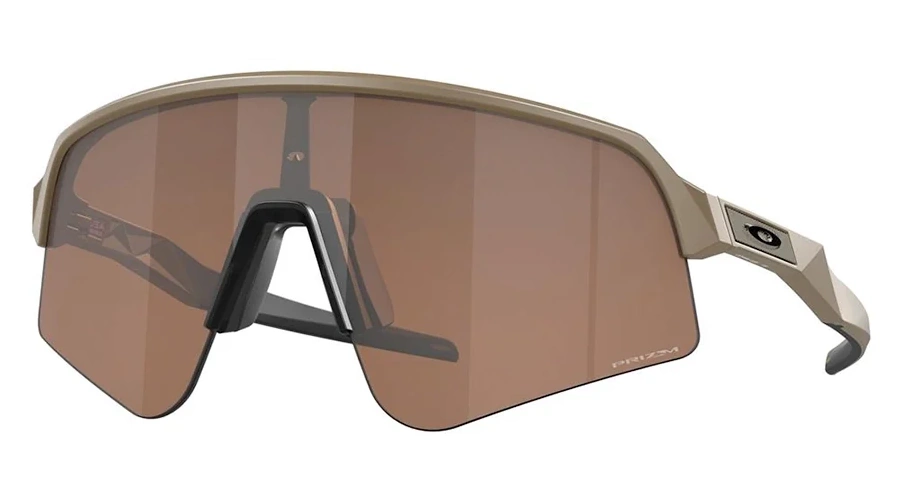
The Sutro family helped make oversized shield sunglasses almost normal away from the professional peloton, and the Oakley Sutro Lite Sweep is arguably one of the easiest versions to recommend to recreational and serious riders alike.
Oakley combines the distinctive swept lens with a semi-rimless sport construction. The large shield gives you substantial coverage and a broad field of vision, while Unobtainium nose pads help keep the glasses in position when sweat starts to build. Oakley's lightweight O Matter frame material is used for the supporting structure, and selected versions feature lens ventilation.
For road cycling, a Prizm Road version is particularly logical. Oakley lists the Prizm Road lens at 20% light transmission and designs the technology to increase color and contrast rather than simply darkening the view.
Best for: Road cycling, fast group rides and riders who want generous coverage without moving to Oakley's more extreme race designs.
If you like the broader Oakley performance aesthetic, you can also browse the current selection of Oakley sunglasses.
Source: Oakley - Sutro Lite Sweep.
2. Oakley Encoder
The Encoder is one of those models that makes more sense once you put a helmet on.
Its low-profile temples were specifically designed with hats and helmets in mind, while the frameless shield wraps farther around the face than conventional sunglasses. Oakley calls the lens construction PhysioMorphic Geometry, using carefully controlled rigidity in the lens itself rather than relying on a conventional frame surrounding it.
That produces a very open field of view. There is less visual interruption around the edges, and the wrap offers substantial protection from wind and debris.
Retention comes from Unobtainium contact points around the nose and ears. The model is available with different Prizm lenses for varying conditions. Cycling Weekly's 2026 testing still puts the Encoder at the top of its overall cycling sunglasses recommendations, specifically praising its clarity, coverage and secure fit.
There is one trade-off worth knowing: the Oakley Encoder is not really built around frequent lens swapping. Riders who routinely change between clear, dark and low-light lenses may prefer a more modular design.
Best for: Road riders, racers and anyone wanting excellent peripheral vision with very good helmet integration.
Source: Oakley - Encoder.
3. 100% Speedcraft
The Speedcraft has genuine cycling pedigree. 100% identifies cycling as one of its primary intended sports for the model, and the frame has long been associated with professional racing, including former world champion Peter Sagan.
Its large cylindrical shield gives a broad view in the riding position, while small lower air scoops encourage airflow behind the lens. Ultra Grip rubber is used at the contact points to help the glasses stay in place when the rider is sweating.
The lens system is a major reason to consider it. 100%'s HiPER technology is designed to increase contrast and depth perception, and the Speedcraft is also offered in other configurations including photochromic options. The current design uses a 5.5-base cylindrical shield, hydrophobic and oleophobic treatments, UV protection and an impact-rated polycarbonate lens. Replacement lenses are available for different light conditions.
That interchangeability gives the Speedcraft an advantage for riders who want one frame and several lenses rather than several complete pairs of sunglasses.
Best for: Road racing, fast training and cyclists who want a proven large-shield design with interchangeable lens options.
Source: 100% - Speedcraft.
4. Smith Wildcat
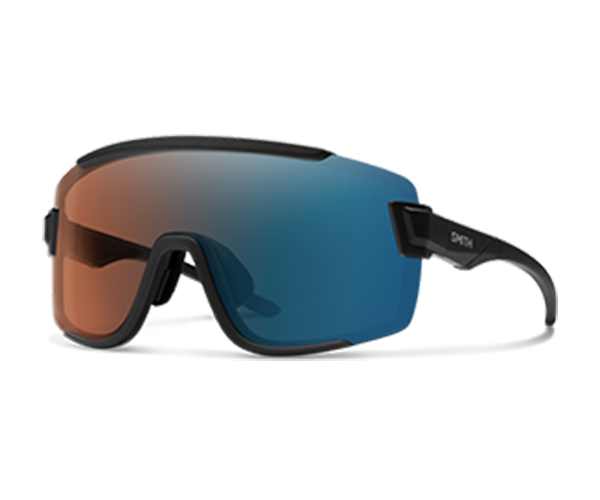
The Wildcat sits somewhere between sunglasses and lightweight goggles, and that is exactly why it works so well for certain riders.
Smith describes it as offering goggle-like coverage with the feel and airflow of sunglasses. The ChromaPop lens is intended to improve contrast and natural color definition, while a second clear lens is included with many configurations. The glasses use adjustable Megol nose pads and Megol temple contact points for grip.
Unlike some race-focused shields, the Smith Wildcat is especially convincing for mountain biking, gravel and unpredictable weather. The extra-large coverage protects well from dirt, branches and wind, yet the lens sits in a way that allows useful airflow. Smith lists 100% UV protection, a 5-base cylindrical lens and a hybrid TR90 and TPU frame.
The clear secondary lens is also more useful than it sounds. Riders who start before sunrise, finish after sunset or spend a lot of time under dense tree cover can change lenses instead of trying to see through an overly dark tint.
Best for: Mountain biking, gravel, mixed-light riding and cyclists wanting near-goggle coverage without wearing goggles.
Browse more Smith Optics sunglasses if the Wildcat shape is larger than you prefer.
Source: Smith Optics - Wildcat.
5. Rudy Project Cutline
The Rudy Project Cutline takes a more modular approach than most large cycling shields.
Its standout feature is the removable bumper system. The lens can be configured with upper and lower sections, only one bumper, or effectively without the surrounding bumpers. That lets riders alter the balance between protection, appearance and airflow.
The large cylindrical lens is specifically positioned by Rudy Project for road cycling, mountain biking and gravel riding. Depending on configuration, the Cutline is offered with technologies including ImpactX photochromic lenses, mirrored RP Optics lenses and polarized Polar 3FX options.
Photochromic versions are particularly interesting for riders whose routes move constantly between sun and shade. Instead of stopping to change lenses, the lens responds to changing UV conditions.
There is also support for an optical insert, which makes the Cutline relevant to cyclists who require prescription correction but still want the coverage of a modern shield.
Best for: Riders who value adjustability, changing light conditions and a highly configurable performance frame.
Source: Rudy Project.
6. Oakley Velo Kato
The Velo Kato is not subtle. It is also one of the most technically ambitious cycling sunglasses in this group.
The enormous lens wraps closely around the face and extends across the bridge of the nose, producing exceptional peripheral coverage. The design minimizes the gaps through which wind normally reaches the eyes, something that becomes noticeable on cold descents or at racing speeds.
Cyclingnews tested the Oakley Velo Kato extensively and gave its field of vision, lens performance, comfort and retention exceptionally high marks. The tester described the Prizm Road lens as outstanding and reported wearing the glasses through a 200 km ride without needing to readjust them. The tested pair weighed 41 grams.
There are compromises. The arms do not fold in the conventional way, the lens is not designed for quick swapping, and the styling will be far too aggressive for riders hoping to use the same pair casually after a ride.
For performance-first riders, however, those drawbacks may not matter much. FashBrands currently lists Velo Kato configurations with Prizm Road lenses and 100% UVA and UVB protection up to 400 nm.
Best for: Racing, high-speed road cycling and riders who prioritize maximum coverage and field of vision over everyday practicality.
Sources: Cyclingnews - Oakley Velo Kato review and FashBrands - Oakley Velo Kato.
7. Smith Syncline
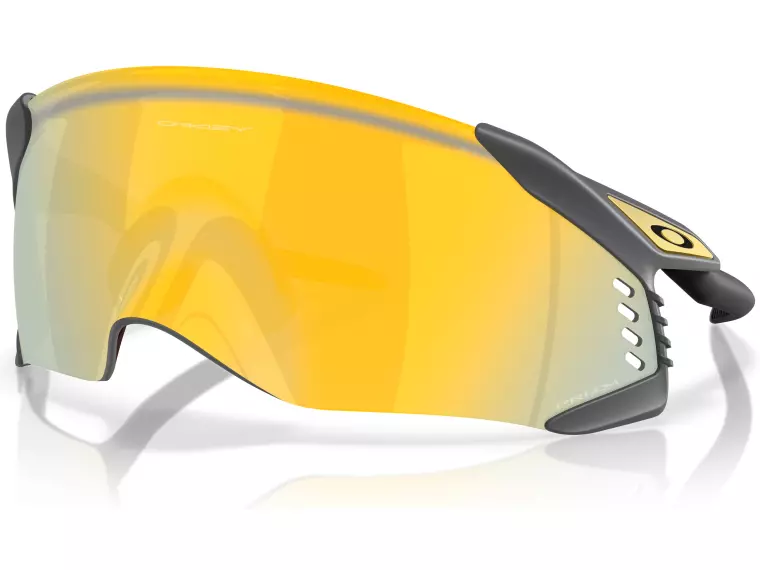
The Syncline is the newest-feeling design in this selection and takes Smith's large-coverage concept even further.
Smith describes it as "bike-ready" and gives it a large fit with extra-large coverage. The cylindrical shield uses ChromaPop technology, while interchangeable lens construction makes it more adaptable than several fixed-lens competitors. Certain versions use ChromaPop photochromic lenses for changing conditions.
The practical details are well thought out. Built-in venting helps control moisture, the frame includes an integrated bumper designed to work cleanly with a helmet, and two-position Megol nose pads allow some adjustment. Megol is also used at the temples to improve grip.
Smith lists a 148 mm lens width and 65 mm lens height, which tells you immediately that this is not a discreet pair of sunglasses. It is meant to cover a lot of your face. A bonus clear lens, performance case and microfiber bag are also included. Smith currently presents the Syncline alongside its cycling equipment as an all-new model designed to work with its bike helmets.
Best for: MTB, gravel and riders who want modern oversized coverage with interchangeable lenses and strong helmet integration.
Source: Smith Optics - Syncline.
Which cycling sunglasses are best for you?
There is no single model here that wins every category.
For a road cyclist wanting a proven all-round option, the Oakley Encoder is difficult to argue against. It has strong independent testing behind it, excellent coverage and a design that works particularly well with helmets.
For riders who prefer the visual style of the Sutro family, the Oakley Sutro Lite Sweep offers a slightly more conventional and versatile alternative. The 100% Speedcraft makes sense if interchangeable lenses are a priority.
Off-road, the Smith Wildcat remains a particularly practical option because of its coverage and included clear lens, while the Smith Syncline brings a newer, even larger approach to the same broad category.
The Rudy Project Cutline stands out for customization and changing-light options. At the performance extreme, the Oakley Velo Kato provides remarkable coverage and field of vision, but its price, size and unusual construction make it a more specialized choice.
The useful rule is simple: buy for the riding you actually do. A racer riding exposed roads at midday has different needs from a mountain biker moving in and out of dense forest, even if both products are sold under the label "cycling sunglasses."
Are expensive cycling sunglasses worth it?
Sometimes.
Higher-priced cycling sunglasses often bring better optical technologies, coatings, adjustable components, lighter materials, improved ventilation or more sophisticated lens geometry. Cyclingnews' examination of premium versus budget cycling glasses points to those areas as some of the genuine differences behind the price gap.
But price alone does not create a good fit. A $300 pair that presses against your helmet or slides down your nose is a worse cycling sunglass for you than a less expensive frame that fits correctly.
Fit should always win.
Source: Cyclingnews - Cheap vs expensive cycling glasses.
Should you choose photochromic cycling sunglasses?
Photochromic lenses are particularly useful when light changes repeatedly during the same ride. Think early-morning starts, forest trails, mixed cloud, long endurance rides or routes that alternate between exposed roads and heavy shade.
A fixed dark lens is usually simpler for consistently bright conditions. Riders in variable light may get more practical value from photochromic technology or a model with interchangeable lenses.
Just remember that "more technology" does not automatically mean "better." The best lens is the one that lets you see comfortably and clearly throughout your normal ride.
A final check before buying
Before choosing from the current range of performance and sport sunglasses, check three things carefully: how the frame fits your face, whether it works with your helmet and whether the lens matches the conditions you ride in most often.
Once those basics are right, features such as Prizm, ChromaPop, HiPER, interchangeable lenses and photochromic technology become genuinely useful rather than specifications on a product page.
Among the seven models covered here, the Oakley Encoder and Sutro Lite Sweep are strong all-round road choices, the Speedcraft remains a proven race-oriented option, the Wildcat and Syncline make a lot of sense off-road, the Cutline offers exceptional adaptability, and the Velo Kato is aimed squarely at cyclists who want maximum performance and coverage.
There is plenty of personal preference involved in cycling eyewear. There should be. You are going to spend hours looking through it, sweating into it and wearing it directly beneath your helmet. Choose accordingly.